Traveler's Guide:
What to see in San Fracisco: Top 13 attractions and 3D model
„City by the bay“
Early history of San Francisco
The history of San Francisco dates back to the late 18th century, when Spanish settlers founded the Presidio and Mission San Francisco de Asís in 1776. Initially, it was a small settlement on the coast of California, which became part of Mexico after the declaration of independence in 1821. In 1846, the United States took control of the territory, and the city's transformation was kickstarted by the discovery of gold in 1848. The Gold Rush quickly turned San Francisco into a bustling port and commercial center.
If you are wondering what to see in San Francisco today, read on — tips for the most interesting places and attractions that this exceptional city offers await you.
Growth and innovations of San Francisco
In the 20th century, San Francisco developed into a major center of innovation, culture, and technology. Thanks to its diverse population, the city played an important role in the counterculture movement of the 1960s. At the same time, it became a financial powerhouse, with nearby Silicon Valley driving the technological progress that changed the world. Silicon Valley poháňalo technologický pokrok, ktorý zmenil svet.
Modern San Francisco
Today, San Francisco is famous for iconic landmarks such as the Golden Gate Bridge, Alcatraz Island, and its famous hills. With a population exceeding 800,000 residents, it thrives as an important cultural and economic center. It is known for technological innovations, top-notch gastronomy, an art scene, and diverse communities, making it one of the most famous cities in the world. The nickname "City by the bay" reflects its stunning coastline and unique geography, which contribute to its exceptional charm.

What to see in San Francisco?
- Golden Gate Bridge – The iconic red suspension bridge offers breathtaking views and is a must-visit stop. You can walk across it, ride a bike, or drive over it.
- Alcatraz Island – Visit the famous former prison on an island in the bay. Take a ferry ride, explore the prison, its history, and views of the city.
- Fisherman's Wharf – A bustling waterfront area full of shops, restaurants, and attractions like Aquarium of the Bay and Pier 39, also famous for the sea lions lounging there.
- Golden Gate Park – A sprawling city park with numerous gardens, museums, and relaxation spaces. Definitely don't miss the Japanese Tea Garden and the de Young Museum.
- Lombard Street – Known as the "crookedest street in the world" with eight sharp turns. A great spot for a photo!
- Chinatown – The largest Chinatown outside of Asia. Explore bustling markets, temples, restaurants, and colorful murals.
- Cable Cars – Ride the historic cable cars for a classic San Francisco experience. They operate over the city's steep hills.
- Coit Tower – Climb this 64-meter tower and enjoy panoramic views of the city and bay, as well as wonderful murals inside.
- Palace of Fine Arts – A stunning architectural landmark in the Marina District, ideal for a peaceful walk and beautiful photos.
- The Painted Ladies – Famous Victorian houses opposite Alamo Square Park. A popular spot for photos with the city skyline in the background.
- Mission District – Famous for colorful murals (especially Mission Murals), great Mexican food, and stylish boutiques.
- Exploratorium – An interactive science museum with hundreds of exhibits – ideal for families and curious minds.
You can find further inspiration on what to see in San Francisco at this link – and you can also buy tickets for the mentioned attractions there!
What can you see on your 3D model?
If you are the owner of our San Francisco 3D model, you can see not only modern skyscrapers on it, but also the historical charm of this exceptional city.
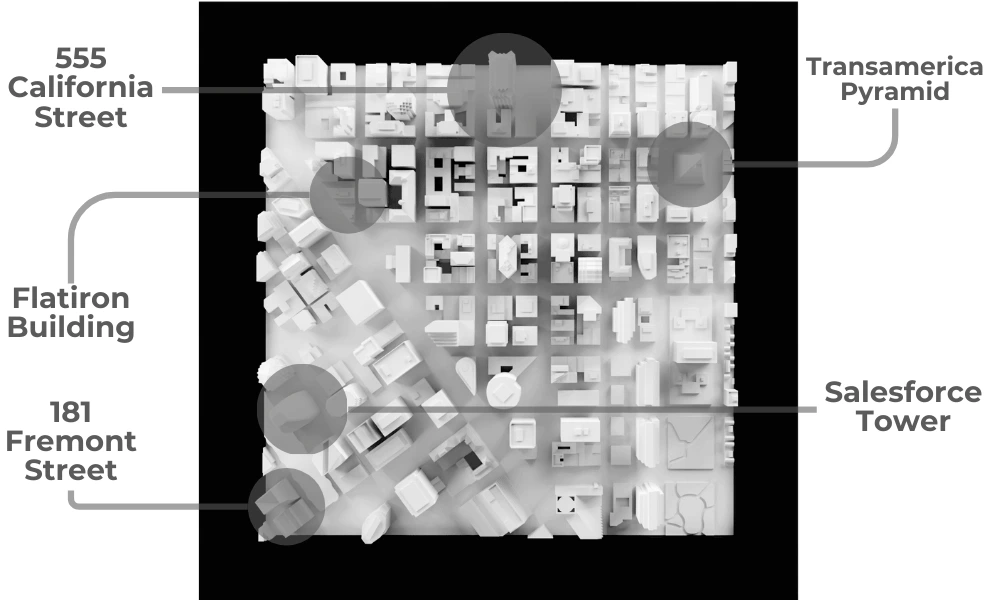
Transamerica Pyramid is the most prominent skyscraper in San Francisco and a symbol of its modern skyline. Designed with an emphasis on resilience and innovation, its unique pyramid shape was chosen to let more natural light onto the streets below. During the 1989 Loma Prieta earthquake, the top of the building swayed more than 30 centimeters, yet remained completely undamaged – a testament to cutting-edge engineering. The building also houses a time capsule scheduled to be opened in 2094, adding a touch of mystery and future heritage to the entire structure. The skyscraper also features a private observation deck, available only to tenants, offering breathtaking views of the entire bay. Its aluminum top is illuminated at night, making the building visible from various parts of the city and remaining an unmistakable landmark.
The San Francisco version of the Flatiron Building presents a unique take on the iconic New York structure. It is slightly "thicker" than its more famous counterpart, but retains the characteristic triangular shape, offering an original interpretation of this classic architectural style. Notably, it belongs to the small number of buildings that survived the devastating 1906 earthquake. This fact gives it not only historical significance, but further underlines its architectural charm and resilience.
As the tallest office building on the US West Coast, Salesforce Tower dominates the San Francisco skyline. With its height exceeding the iconic Transamerica Pyramid, it has become a modern symbol of the city's growth and modernization. At the top of the tower is Day for Night by Jim Campbell – the largest permanently installed LED art piece in the world. This light installation, visible from many parts of the city, transforms the building into a nighttime canvas that reflects the movement and atmosphere of the city in real time. Salesforce Tower is not only an architectural marvel, but also an expression of San Francisco's technological progress and creative identity.
181 Fremont Street is the tallest fully residential building in San Francisco and represents the peak of luxury urban living. A unique feature is the private sky bridge, which directly connects the building to Salesforce Park, providing residents with exclusive access to this green oasis in the heart of the city. Every apartment in this high-rise tower sold for an average price of over $3 million, which testifies to its exceptional status and prestige. The building combines elegant design, cutting-edge technology, and luxury amenities, making it one of the most exclusive residential addresses in San Francisco.
555 California Street, formerly the most expensive office building on the West Coast, holds great cultural and financial significance. Its imposing architecture and central location make it a prominent feature of the city skyline. It frequently appears in films, including the classic Dirty Harry, earning a place in pop culture as well. Part of the ownership of this building belongs to Donald Trump, bringing the building media attention and quite a bit of controversy. 555 California Street thus connects the worlds of business, politics, and Hollywood, making it one of the most interesting addresses in San Francisco.

13 Interesting Facts
The Golden Gate Bridge stretches for 2.7 kilometers (1.7 miles) and is supported by two towers standing 227 meters (746 feet) tall. Construction took 4 years (1933 – 1937), and upon opening it became the longest suspension bridge in the world. Originally, the bridge was supposed to be painted with black and yellow stripes to make it more visible in the heavy foggy climate of the bay. However, the architect decided otherwise – choosing the striking color International Orange, which has since become an iconic symbol of the city. Maintaining the bridge requires approximately 38,000 liters of paint annually, making it not only a technical marvel, but also a work of art that requires constant care.
The famous fog in San Francisco is affectionately nicknamed Karl the Fog by locals. This fog even has its own Twitter and Instagram accounts, where it shares witty posts and stunning foggy shots of the city – often with a heavy dose of personality and humor. The fog occurs on average about 108 days a year, most frequently during the summer months when cold ocean air meets warmer inland air. Karl the Fog has thus become an inseparable part of San Francisco's identity, adding a mysterious yet poetic atmosphere to the city.
The former federal prison on Alcatraz Island operated for 29 years (1934 – 1963) and incarcerated over 1,500 prisoners, including one of the most famous mafia bosses – Al Capone. This dreaded gangster is one of the most iconic figures ever held here. During his stay, Capone even formed a band called The Rock Islanders, in which he played the banjo. The prison provided inmates with warm showers – do not mistake consideration for cunning. Prisoners showered in warm water so they wouldn't get used to the icy waters of the bay, which reduced the chances of a successful escape. Despite 14 escape attempts, officially no one ever escaped – at least according to records. Alcatraz thus earned a reputation as the "inescapable prison" and is today one of San Francisco's most visited attractions, drawing lovers of history, mysteries, and gritty stories.
Chinatown in San Francisco spans 24 city blocks, making it one of the largest Chinatowns outside of Asia. It has existed for over 170 years and welcomes over 1 million visitors annually. Although many associate them with traditional Chinese cuisine, fortune cookies, which are now an integral part of American-Chinese food, were invented right here – in San Francisco – at the beginning of the 20th century. At the Golden Gate Fortune Cookie Factory, right in Chinatown, more than 10,000 fortune cookies are produced daily. Visitors can watch the entire production process and even create their own personalized message – all in the place where this tasty symbol was first born.
According to estimates, approximately 120,000 dogs live in San Francisco, while the number of children under 18 years old is around 115,000. This confirms the popular local rumor that there are more dogs than children in the city. This fact beautifully captures the culture of the city, where pets are considered full-fledged family members. Many restaurants, cafes, parks, and even offices are dog-friendly, and on every corner you will find dog boutiques, salons, or parks. Thus, San Francisco is not just a paradise for people, but also a true dog city!
Cable cars in San Francisco have been operating since 1873, making them among the oldest functioning transportation systems of their kind in the world. Originally the city had 23 lines, but today only 3 historic routes remain in operation, which serve not only as a means of transport, but also as a living museum on rails. Each cable car moves at a speed of approximately 15 km/h (9.5 miles per hour) and riding it offers an unforgettable experience – from views of steep hills to the nostalgic sound of the bell and the characteristic scent of oiled wood. Today, San Francisco cable cars are a National Historic Landmark and an inseparable part of the city's identity. For many tourists, they represent a "must-do" during their visit.
San Francisco is a true haven for coffee lovers, as it is home to more than 300 cafes within the city limits alone. This means there is approximately one cafe for every 2,300 residents. From stylish artisanal roasters to cozy family-owned cafes, the city offers countless flavors, styles, and atmospheres – ideal for anyone who enjoys a cup of espresso, cappuccino, or pour-over coffee. Thus, San Francisco is not only a city of innovation and beautiful architecture, but also a coffee metropolis, where every day can start exceptionally – with exceptional coffee.
San Francisco serves as the gateway to Silicon Valley – the world's leading center of technology and innovation. This region is home to tech giants such as Apple, Google, Facebook (Meta), Tesla, and Netflix, as well as thousands of startups. This concentration of technology companies has significantly shaped the city's economy, culture, and skyline, attracting top talent from around the world. The presence of these influential firms has also led to a surge in innovation, venture capital investment, and technological progress that impacts industries worldwide.
The row of colorful Victorian houses known as the Painted Ladies is among the most photographed places in San Francisco. They are also nicknamed "Postcard Row" and appeared in the opening credits of the TV series Full House.
Levi Strauss invented blue jeans in San Francisco during the Gold Rush in 1873. The headquarters of Levi's is still located directly in this city today.
San Francisco is known for its hills – there are as many as 48 within the city limits. The steepest of them is Filbert Street with a gradient of 31.5%. The famous crooked section of Lombard Street has up to 8 sharp turns on a single block (younger generations may remember this iconic street from the game GTA San Andreas, where it was depicted in the city of San Fierro). The gradient of this street is approximately 27%, making it not only a picturesque, but also a challenging place for drivers.
The San Francisco earthquake of 1906 lasted only 42 seconds, yet destroyed nearly 80% of the city. The devastation was further worsened by a massive fire that lasted four days. The total damage at the time was estimated at $524 million, which would amount to billions today. Despite the widespread destruction, some iconic buildings, such as the Flatiron Building, survived, making them rare historical landmarks and reminders of the city's resilience.
Thanks to its unique climate, San Francisco does not experience typical four seasons. The weather is known for its unpredictability – fog, wind, and sun can alternate within a single day. Interestingly, the warmest month is often September, not July, as one might expect.
Our 3D models, just for you.
Our exclusive 3D city models bring the world's most iconic skylines and landmarks to life with stunning accuracy – perfect for travelers, architecture lovers, and urban enthusiasts.