Traveler's Guide:

What to See in Rome: Top 11 Attractions and a 3D Model

"All roads lead to Rome"

residents
0 M+
most visited city in the EU
0
area
0 km²
tourists annually
0 M+
4 papal basilicas
0

The Beginnings of Rome

Legend says that Rome was founded by the brothers Romulus and Remus in 753 BC. From a modest settlement on the seven hills grew the center of one of the most powerful empires in history. The Roman Empire shaped Europe's politics, law, architecture, and culture, and its legacy is felt to this day. In the Middle Ages, Rome became the seat of the popes, and Vatican City was born, the spiritual center of the Catholic Church. Today's Rome is a unique mix of ancient ruins, Renaissance palaces, baroque fountains, and vibrant streets.

Rome Today: History, Art, and Life

Rome is a place where antiquity seamlessly blends into the present: espresso murmurs by ancient walls, a violinist plays in the squares, and the scent of pizza and fresh pasta drifts from narrow alleys. The "Eternal City" doesn't only entice with icons and big names; true magic can also be found off the beaten path – in the maze of streets by the Tiber River, housing tiny trattorias, boutiques, and artisan workshops. In the evening, take a light stroll through the *centro storico*: squares with fountains, the Trevi Fountain, and the Spanish Steps – simply unadulterated Italian romance.

Rome is not just about history but also gourmet experiences: enjoy cheesy cacio e pepe, authentic carbonara, crispy supplì, a scoop of gelato, and an evening aperitivo with light snacks. For sunset, head up to Terrazza del Pincio above Piazza del Popolo or to the Orange Garden (Giardino degli Aranci) on the Aventine Hill – the city unfolds right beneath your feet. Rome wins you over not only with its monuments, but with a pace that teaches you to slow down: walking along the Tiber, sipping espresso at a bar, and letting yourself be carried away by the evening murmur of the squares. And if you want to take a piece of that atmosphere home, check out our 3D model of Rome.

What to See in Rome?

  1. Colosseum – the symbol of Rome and the largest amphitheater of antiquity, where gladiatorial games once took place. Save another look for the underground as well: the hypogeum served as the underground "backstage" for gladiators and show props.
  2. Roman Forum – the center of political and social life in ancient Rome. Today, you can walk across its ancient stones and feel where history was written.
  3. Pantheon – a perfectly preserved ancient structure with a massive dome. Light pours in through the opening in the dome (the oculus), creating a beautiful cone of light.
  4. Vatican and St. Peter's Basilica – one of the largest basilicas in the world and the seat of the Pope. The dome offers one of the most stunning views of the entire city.
  5. Sistine Chapel – Michelangelo's frescoes rank among the pinnacles of Renaissance art. You will see the ceiling featuring prophets and the famous Last Judgment on the altar wall.
  6. Piazza Navona – a baroque square featuring fountains and cafes. Its dominant feature is Bernini's Fountain of the Four Rivers alongside a vibrant cafe culture atmosphere.
  7. Trevi Fountain – the most famous fountain in Rome, where throwing a coin is said to guarantee a return to the city. It is best to visit early in the morning or late in the evening when there are fewer people.
  8. Spanish Steps – a romantic spot offering a lovely view. In the summer they are decorated with flowers, and they are at their most photogenic during sunset.
  9. Castel Sant'Angelo – a fortress and mausoleum of Emperor Hadrian with stunning panoramic views. The roof features a terrace overlooking both the Tiber and St. Peter's dome.
  10. Villa Borghese and Galleria Borghese – an urban park and gallery filled with works of art. The park is ideal for cycling or a picnic, but be sure to book your gallery entry for an exact time slot due to high visitor numbers.
  11. Catacombs – underground cemeteries from the early Christian period (e.g., St. Callixtus or Domitilla). Entry is only possible with a guide, which enhances the overall experience.

At this link you will find more inspiration on what else to see in Rome – and you can also buy tickets for the mentioned attractions right here!

What can you see on your 3D model?

If you own our 3D model of Rome, you have the Colosseum in the palm of your hand and the entire heart of the Eternal City right in your home.

The Colosseum is the symbol of Rome and the largest amphitheater of antiquity. The crowd once roared here during gladiatorial games. The stands held approximately 50 to 65 thousand spectators, and 80 entrances ensured quick arrivals and departures. Beneath the wooden floor covered in sand lay the hypogeum – a network of corridors, cages, and elevators. It served as a backstage area for gladiators and animals as well as a technical stage that changed the flow of performances. A canvas awning (velarium) could be extended above the stands, with the ropes and sails maintained by sailors of the imperial fleet.

Admission for citizens was often free, but seating was strictly divided according to social status. Some sources also mention attempts at re-enacting naval battles, though historians still debate how feasible they actually were.

Today, the Colosseum is part of the UNESCO World Heritage and ranks among the most visited monuments in Europe. Even after two thousand years, it remains monumental, and at first glance, you can feel that great stories were born here. Every visit is a small journey back in time.

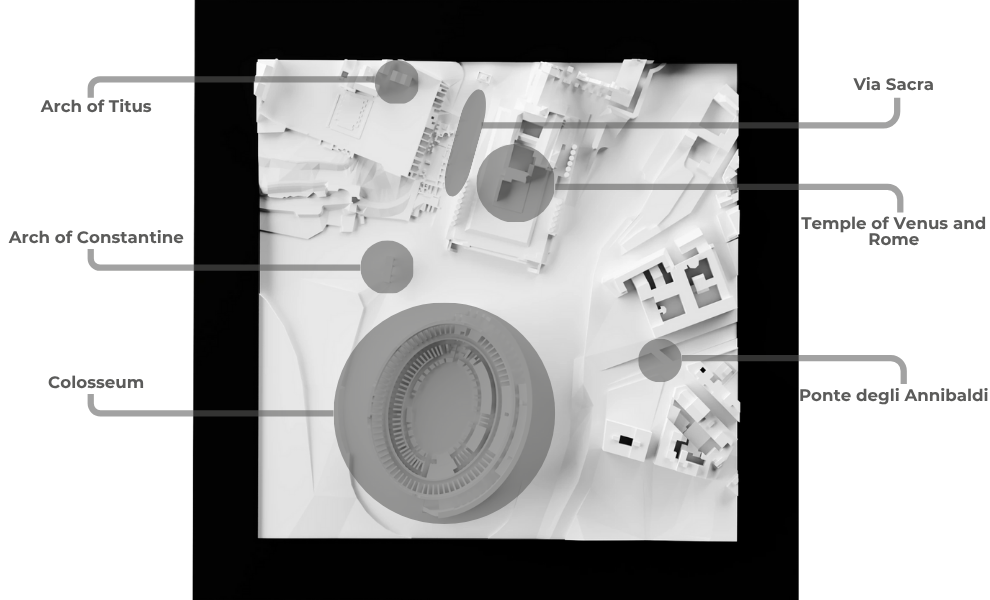
The Arch of Constantine stands between the Colosseum and the Palatine Hill and is one of the most beautiful triumphal arches in Rome. It was completed and officially dedicated in AD 315 to commemorate Emperor Constantine's victory at the Battle of the Milvian Bridge (312). The structure, featuring three archways and rich sculptural decoration, is one of the best-preserved monuments of late ancient Rome.

A significant portion of the decoration comes from older monuments: Roman masters "recycled" reliefs and statues from the times of Trajan, Hadrian, and Marcus Aurelius, complementing them with new panels featuring Constantine. As a result, different artistic styles can be seen side by side on a single monument. At the top stood statues of Dacian prisoners, on the sides are hunting and sacrificial scenes, and on the central panels the emperor distributes gifts to the people.

The main inscription features the Latin words INSTINCTU DIVINITATIS – translated as "by divine inspiration" or "at the prompting of a deity." The formula is deliberately ambiguous: to pagans, it could sound like the favor of the gods, while to Christians, it suggested guidance by the one true God. In practice, Constantine implies that he triumphed with the help of a higher power. The arch stood along the route of triumphal processions and, together with the Colosseum, completes the iconic backdrop of Via Sacra.

The Arch of Titus stands on Via Sacra near the entrance to the Forum, a short distance from the Colosseum. It was completed by Emperor Domitian in AD 81 in honor of his brother Titus and his victory in the capture of Jerusalem in 70. It features a single archway, elegant columns, and an ornate vault.

Inside are famous reliefs. On one panel is the triumphal procession with spoils from the Temple in Jerusalem – you can notice the seven-branched menorah, trumpets, and other objects. On the opposite panel, Titus is in a chariot with four horses, crowned by the goddess of Victory. In the center of the vault is an eagle symbolically carrying him to the gods.

The arch stood along the route of victory processions and, together with the Colosseum, completes the iconic backdrop of Via Sacra. It is most pleasant in the morning or late afternoon when there are fewer tourists and the reliefs stand out better.

The main ancient street of Rome. It led from the Colosseum through the Roman Forum all the way to the Capitoline Hill, and emperors, priests, and entire victory processions walked along it. Today, you can walk it on foot, occasionally stepping on original stones.

Along the way, you pass the best of antiquity: right at the entrance from the Colosseum is the Arch of Titus, followed by the ruins of grand basilicas and temples, the quiet courtyard of the former House of the Vestals – priestesses of the goddess Vesta who guarded the eternal flame – and the building of the Senate (Curia). At the end near the Temple of Saturn, a lovely view of the entire forum opens up.

A large terrace between the Colosseum and the Forum offering peace in the middle of Rome's busiest area. A double temple once stood here. One sanctuary belonged to Venus, the other to the personification of the city of Rome. It was among the largest temples in ancient Rome, and tradition says that Emperor Hadrian even participated in its design. After a later earthquake, it was restored by Emperor Maxentius.

Both parts stood back-to-back, one facing the Forum and the other toward the Colosseum, creating a wide platform with views on both sides. Today, you will see the remains of columns, walls, and curved rear sections of the temple along with a large flat area where you can catch your breath for a moment and take some great shots.

A short stone viaduct near the Colosseum, built in the late 19th century during major renovations of Rome following the unification of Italy. It is not ancient, but rather an urban "bridge" that spans a depression in the terrain, connecting the Esquiline slope with the area around the arena. Thanks to its position above the road, it offers an iconic view of the Colosseum. Today, it serves as an ordinary road bridge and is a popular spot for photos of the Colosseum.

10 Interesting Facts

The designation "Roma Aeterna" has been used since antiquity. Rome is rightfully called the "Eternal City" because for over two thousand years it has ranked among the centers of civilization. According to legend, it was founded in 753 BC by the brothers Romulus and Remus on the Palatine Hill, where they were reportedly saved and nursed by a she-wolf. The Palatine is precisely one of the seven hills of Rome – along with the Aventine, Capitoline, Esquiline, Viminal, Quirinal, and Caelian – which formed the core nucleus of the city. From these hills, Rome gradually expanded and became the heart of an empire that ruled three continents.

Have you heard the saying "All roads lead to Rome?" – well, this epithet is by no means accidental either. Already in antiquity, the Romans built a network of roads over 80,000 kilometers long that connected the entire empire with its center. Many of them have survived to this day and form the basis of the Italian road network.

Vatican City is the smallest state in the world – a tiny 0.44 km² and about 800 inhabitants – yet its history is immense. It was born in 1929 with the signing of the Lateran Treaties and remains an absolute monarchy to this day, where the Pope is also the head of state. Up to 300,000 people crowd St. Peter's Square during audiences, while inside St. Peter's Basilica, sacred monumentality intertwines with precise craftsmanship. Vatican City survives on contributions from the faithful, admission fees, and small "flagship" symbols: its own stamps, coins, post office, radio, and newspapers – and yes, the ATM here offers a menu in Latin.

The biggest attraction is the Vatican Museums with more than 20,000 works of art, visited annually by over 6 million people. Their heart is the Sistine Chapel with Michelangelo's ceiling covering an area of approximately 500 m², where art and church history tower above tourists and the conclave alike. Maintaining order is the Swiss Guard – an elite corps of about 135 men who must be Catholic, single, and of Swiss nationality. Vatican City is thus a miniature world with its own rhythm: ancient yet surprisingly "functional" – from the stamp on a postcard to the quiet chapel where the future of the church is decided.

Italians consider cappuccino after 11 AM to be a "barbaric custom," so tourists with one in the afternoon are instantly recognizable.

One interesting fact about the Colosseum is that "naval battles" could also take place there – the arena was designed so that it could be flooded with water to imitate the sea. The Romans could thus treat spectators not only to gladiatorial games but also to miniature naval skirmishes.

The Pantheon in Rome is an ancient temple to "all the gods," which in its current form was built by Emperor Hadrian around AD 118–125 (on the site of Agrippa's structure from 27 BC). It features a famous concrete dome with a diameter of 43.3 m and an oculus opening about 9 m wide, through which light and rain stream in – the latter drained by discreet channels in the floor. In the 7th century, it was converted into a Christian church, which is why it has survived as one of the best-preserved structures of ancient Rome. Inside rest, for example, the painter Raphael and kings Victor Emmanuel II and Umberto I.


In Rome, the trattoria "La Campana" has been operating since 1518 and claims to be the oldest continuously open restaurant in the world.

Rome has over 1,500 fountains – from grandiose baroque ones to small drinking water fountains called "nasoni." They flow continuously and refresh you on a hot day without the need to buy bottles. You just need to block the outlet with your finger, and a jet sprays upward like from a small drinking fountain. Roman-style ecology – practical and free.

The Trevi Fountain is not only the most beautiful baroque fountain in Rome, but also a huge "open-air treasury." Every day, visitors throw in coins worth around 3,000 euros, which amounts to more than 1 million euros annually. The money is collected once a week and goes to charitable projects – mainly to support the Caritas food bank, which helps poor families in Rome. The fountain is 26 meters high, 49 meters wide, and consumes approximately 80 million liters of water per year, although the system is closed and the water is recycled. To this day, the legend holds that if you throw a coin into the fountain, you will surely return to Rome – and judging by the amount of coins, most tourists truly believe it.

In the gate of the Sovereign Military Order of Malta building, there is a tiny keyhole through which the perfectly framed dome of St. Peter's appears. It is a quick stop with a big "wow" effect and one of the most beautiful "secret" viewpoints in the city. Expect a short queue, but it moves quickly. A quiet park with orange trees is just a stone's throw away.

Pons Fabricius has been connecting the mainland to Tiber Island since 62 BC. Walking across it is like passing through a time gate – beneath your feet are the exact same stones as thousands of years before you. At sunset, both the Tiber and the surroundings of the bridge take on rich colors. Combine it with a short walk around the island.

Our 3D models, just for you.

Our exclusive 3D city models bring the world's most iconic skylines and landmarks to life with stunning accuracy – perfect for travelers, architecture lovers, and urban enthusiasts.