A Formula 1 Fan´s Guide
F1 Austrian Grand Prix: 8 Interesting Facts About the Circuit and a 3D Model
„Styrian Grand Prix“
Red Bull Ring – high-speed arena in the heart of the Alps
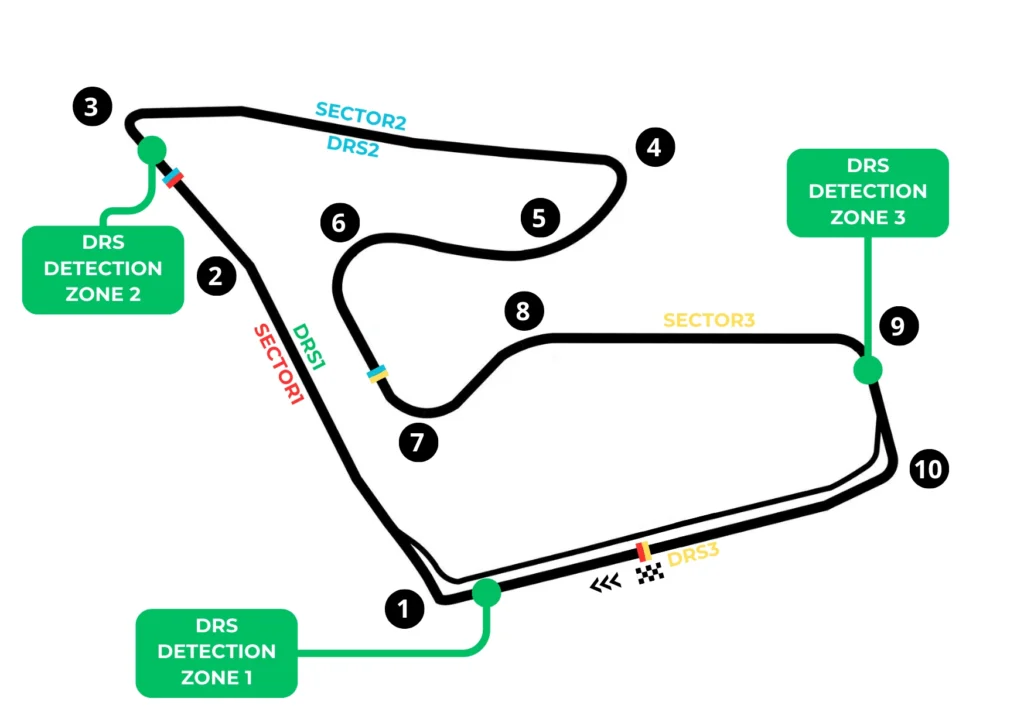
The F1 Red Bull Ring circuit is among the most scenic and fastest tracks on the Formula 1 calendar. Located in Spielberg, Austria, surrounded by the Styrian Alps, it offers a short yet extremely dynamic layout with a length of 4,318 meters. The track features only 10 turns, but thanks to long straights and heavy braking zones, it offers plenty of overtaking opportunities, making it a visually appealing and action-packed race for spectators.
The first Austrian Grand Prix was held here as early as 1970 (on the original Österreichring), but the track returned to the F1 calendar under the name Red Bull Ring in 2014 following extensive reconstruction. Since then, it has become the home racing venue for the Red Bull Racing team and one of the most popular stops for both fans and drivers.
Max Verstappen and his Austrian kingdom
One of the most memorable moments at the Red Bull Ring took place in 2019, when Max Verstappen delivered one of his most impressive performances. After a poor start, he dropped to 8th place, but fought his way back to the front over the following laps. In a dramatic finish, he overtook Charles Leclerc with two laps to go and took victory in front of ecstatic fans - marking Honda's first win in 13 years and a breakthrough moment for Red Bull on home soil. Max Verstappen also dominates this circuit in terms of wins, having triumphed here more than any other F1 driver with a total of five victories.
Drivers’ Opinions on the Circuit
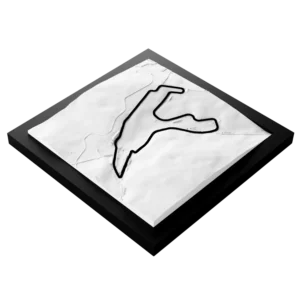
What can you see on your 3D model?
Our 3D model of the Red Bull Ring circuit captures not only legendary corners like Remus (3) or Rindt (9), but also the characteristic atmosphere of the Austrian countryside and the surrounding Alps. Upon closer inspection, you will discover even more details than you would expect.
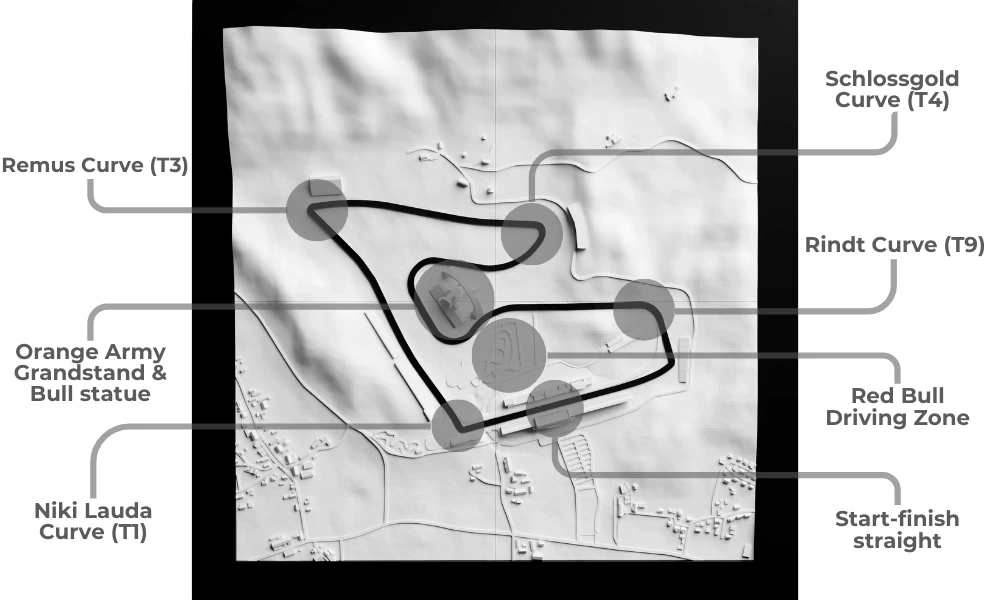
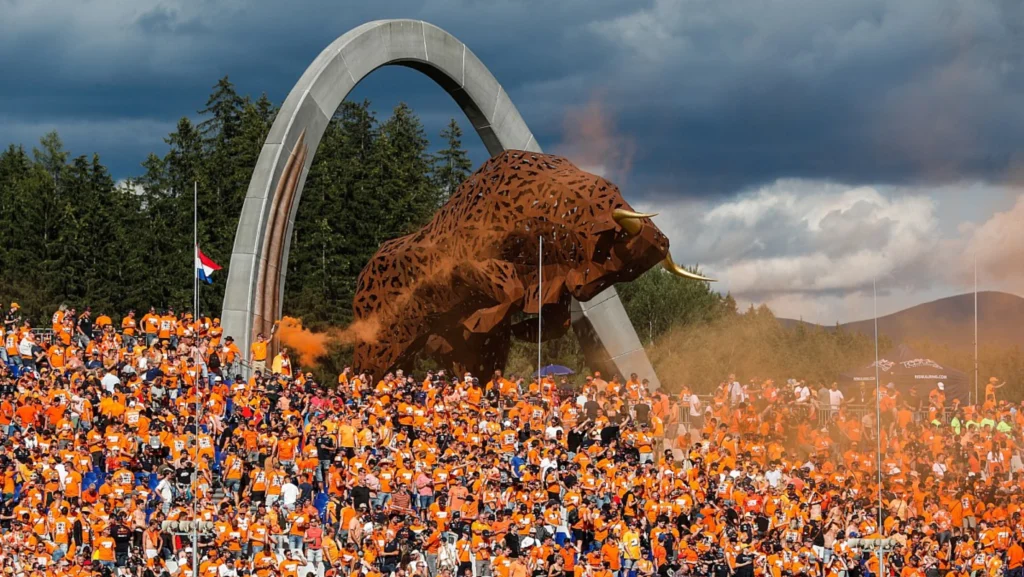
This grandstand turns into a breathtaking orange sea during the F1 weekend. Thousands of Verstappen's fans create noise, smoke, and an atmosphere you won't experience anywhere else. On the model, you can find it right beneath the famous bull statue, which towers over the inner section of the circuit.
The landmark in the center of the circuit is not just any ordinary statue - this gigantic steel bull, including its arch, reaches an impressive height of 17.2 meters and weighs an incredible 68 tons. Its foundation alone was poured into 950 tons of concrete and reinforced with 44 tons of steel!
It is a perfect spot with a view of the start, the entry into the first turn, and the legendary heavy braking into the Remus corner. From above, this grandstand looks like the heart of the entire Red Bull Ring.
Here, tires aren't tortured for lap times, but for the pure joy of driving. Red Bull organizes drift shows, skid schools, promotional events, and experience rides for fans here. On the model, it stands out as a distinct asphalt area in the middle of the track - an unmistakable "playground" for anyone looking to have fun between the corners. The ideal spot for anyone who believes that tires belong on the asphalt, not in a warehouse.
This is where it all begins and ends. The start, the pit lane, the garages, and the victory celebrations—all in one place, right beneath the main grandstand. This is exactly where spectators get a view of the biggest moments of the race: the starting lights, pit stops, and the waving of the checkered flag.
On the model, you can easily recognize it as a long straight with a slightly protruding structure along the track. An ideal spot for any fan who wants to have the race "at their fingertips".
This first corner at the Red Bull Ring is named after the legendary Austrian driver Niki Lauda – a three-time F1 world champion and motorsport icon. Although it looks like a simple right-hand bend on the model, it is actually a technically demanding trap: uphill braking, a narrow apex, and a sharp exit toward the climb to Remus.
This is often where a good start is decided – whether a driver maintains their position or immediately loses valuable places. On the model, you can find it right after the pit lane, and even from above, you can see it as a sharp bend of the track going uphill. Lauda Corner is a tribute to courage, technique, and precision – all the values that this legendary racer embodied.
Racing stories are written here - the legendary heavy braking from 300 to 70 km/h often decides positions in the opening laps. From above on the model, it looks innocent, but in reality, it is one of the most iconic corners on the entire track. If you want something that immediately catches your eye when looking at the model - it's Remus.
Not every overtaking maneuver works out on the first try. That's why drivers try "Plan B" right here - after exiting Remus, they plunge at high speed into this wide, gently descending corner. If someone leaves the door open, it's the ideal spot for a move. On the model, Schlossgold stands out beautifully as a wide arc with a clear view ahead. It's a place where decisions are made not with brute force, but with a cool head.
This corner is named after Jochen Rindt, the only Austrian F1 world champion - and rightfully so. Rindt Curve is fast, sharp, and unforgiving. You don't play it safe here; drivers go flat out, right on the limit. This is often where it's decided whether a qualifying lap ends famously or in the gravel. On the model, you can find it as the final arc before the start-finish straight. It looks elegant, but in reality, it's properly dangerous.
Speed Between the Hills
The Red Bull Ring is a unique circuit set in the picturesque landscape of the Austrian Alps, where the silence of nature is disturbed only by the roar of engines. Thanks to its elevation changes and short lap length, it is one of the fastest tracks on the F1 calendar - yet it is completely unforgiving of mistakes. This is where Michael Schumacher claimed his first podium for Ferrari, and fans regularly flood the grandstands with an orange wave during Verstappen's "home" GP. It is a place where raw power, precision, and true racing heart come together.
7 Interesting Facts
In this section, you will find interesting facts and trivia about the Austrian Red Bull Ring - including seven fascinating moments, challenges, and legendary highlights that made this circuit famous.
The Red Bull Ring has a contract with Formula 1 until 2041, making it one of the longest-contracted circuits on the calendar – just like Miami. This long-term contract highlights the importance of the track itself as well as the influence of the Red Bull brand, which owns it.
Red Bull Ring patrí medzi najkopcovitejšie trate v kalendári Formuly 1. Celkové prevýšenie trate je približne 63–65 metrov, čo ho radí na druhé miesto, hneď po belgickej Spa (102 m). Prudké stúpania a rýchle zjazdy robia z rakúskeho okruhu technicky aj fyzicky náročný test pre jazdcov aj monoposty.
With a length of 4.318 km, the Red Bull Ring is the fourth shortest circuit on the Formula 1 calendar. Its simple and fast layout with only 10 corners allows drivers to achieve the fastest qualifying times - often under 1:04 minutes. This is exactly why the final part of qualifying, Q3, is extremely thrilling - the gaps between drivers are usually within thousandths of a second, and even the smallest mistake can decide whether a driver ends up on the front row or buried in the midfield.
In the 2020 and 2021 seasons, due to the pandemic, the Red Bull Ring hosted up to two Grands Prix in a single season—the traditional Austrian Grand Prix and the additionally added Styrian Grand Prix. In the modern era of F1, this is a true rarity.
Max Verstappen is the "ruler" of this circuit - having won here 5 times since 2018, which makes the Red Bull Ring practically his home track.
During the Austrian Grand Prix, the Red Bull Ring transforms into a sea of orange. Thousands of Max Verstappen fans - known as the "Orange Army" - flood the grandstands every year, creating one of the loudest and most colorful atmospheres in the entire championship. Spielberg often feels more like a Dutch weekend than an Austrian one.
The Red Bull Ring places a strong emphasis on regional cooperation - up to 85% of the main suppliers for the circuit come from Austria, and half of them are directly from Styria. This shows that the circuit supports the local economy and the culture of the region.